
I remember sitting on my bedroom floor in 1989, the hum of a heavy CRT television warming my face, staring at a screen that felt more like a math problem than a game. I wasn’t just mashing buttons; I was trying to decode a language of patterns and consequences. People often mistake puzzle game logic for mere trial and error, or worse, they treat it like a mindless distraction meant to kill time. But if you’ve ever felt that specific, electric spark of clarity when a complex system finally clicks, you know it’s actually about pattern recognition and cognitive discipline. It isn’t about luck; it’s about understanding the rules of the world the developer built for you.
I’m not here to give you a list of superficial “hacks” or tell you to just “think harder.” Instead, I want to help you strip away the frustration and look at the underlying architecture of these challenges. We are going to dive into how to read the system rather than just reacting to it. My goal is to provide you with a practical framework to sharpen your intuition, so you can stop guessing and start playing with intention.
Table of Contents
Cultivating Algorithmic Thinking in Games

When I was younger, I thought winning was just about being fast with my thumbs. But as I’ve delved deeper into the psychology of play, I’ve realized that the real victory lies in how you structure your thoughts. To truly excel, you have to move past trial and error and start embracing algorithmic thinking in games. This isn’t about memorizing a walkthrough; it’s about identifying the underlying rules that govern a system and building a mental sequence to navigate them. It’s the difference between guessing a combination and understanding the mathematical pattern behind the lock.
This shift in perspective is where real cognitive skill development happens. When you treat a level as a series of logical inputs and outputs rather than a chaotic obstacle course, you aren’t just playing; you are training your mind to recognize patterns in the real world. I often find that my best sessions occur when I stop reacting to the screen and start predicting the game’s next move. By breaking complex problems into smaller, manageable steps, you transform a frustrating loop of failure into a deliberate, systematic ascent toward mastery.
Spatial Reasoning Puzzles as Mental Blueprints
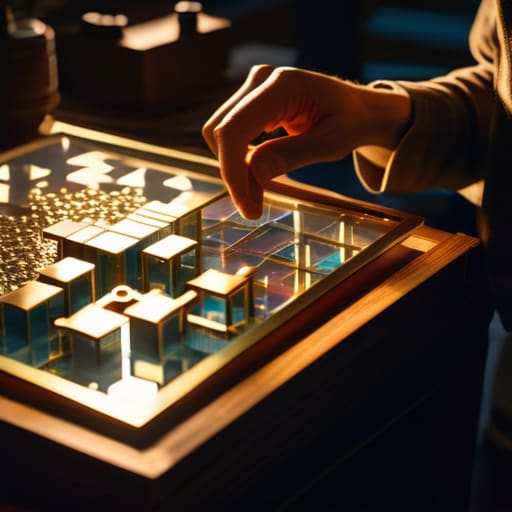
When I’m hunched over a workbench, trying to realign a tiny ribbon cable in a Game Boy Color, I’m reminded that much of gaming is about understanding how pieces fit within a larger whole. This is the core of spatial reasoning puzzles. These games aren’t just asking you to move blocks; they are forcing your brain to construct a mental model of a three-dimensional space using only two-dimensional cues. You aren’t just reacting to what’s on the screen; you are building a blueprint in your mind’s eye, predicting how a rotation or a shift will ripple through the entire environment.
This process is a profound form of cognitive skill development. It’s the difference between stumbling through a level and actually seeing the architecture of the challenge. When you stop treating the screen as a series of obstacles and start seeing it as a structured system of volumes and voids, your approach shifts. You begin to move from trial-and-error to a more deliberate, calculated way of interacting with the game world. It’s about training your mind to visualize the solution before your hands even touch the controller.
Five Ways to Stop Guessing and Start Solving
- Stop the “button mashing” reflex. When you hit a wall, your instinct is to try every possible combination just to see what sticks. That isn’t playing; it’s gambling. Instead, pause, step back from the screen, and treat the puzzle as a set of rules waiting to be decoded.
- Map out the “if/then” scenarios in your head. Most modern puzzle logic is built on conditional statements. If I move this block here, then that lever will trigger. If I don’t visualize these chains of causality before you act, you’re just wasting your own time.
- Isolate the variables. If a level feels overwhelming, stop looking at the whole mess. Focus on one single mechanic—the way light reflects, the way a tile slides, or how a specific enemy moves. Once you master that one piece of the system, the rest of the logic usually starts to fall into place.
- Document your failures. I know it sounds tedious, but knowing what didn’t work is just as vital as knowing what did. If you can mentally (or literally) note that “Pattern A always leads to a dead end,” you’ve effectively narrowed the search space for the solution.
- Embrace the “Aha!” moment by slowing down. There is a specific neurological satisfaction that comes from a breakthrough, but you can’t reach it if you’re rushing. Treat the frustration not as a sign to quit, but as the necessary friction required to sharpen your mental focus.
Playing with Intention: My Core Takeaways
Stop treating puzzles like obstacles to be bypassed; start treating them as systems to be understood. When you shift from reactive clicking to active observation, the logic reveals itself.
Build your mental toolkit by recognizing patterns, not just solutions. The goal isn’t just to beat the level, but to internalize the underlying rules so you can anticipate the next challenge before it even appears.
Embrace the frustration of a mental block as a sign of cognitive growth. That moment of tension is actually your brain remapping its spatial and algorithmic understanding—don’t walk away, just step back, take a sip of tea, and look at the system from a different angle.
The Intentional Player
“A puzzle isn’t just a barrier to overcome; it’s a conversation between the designer’s logic and your own cognitive patterns. If you stop treating the mechanics like obstacles and start treating them like a language, you stop guessing and start understanding.”
Delia Okonkwo
Beyond the Final Level
At its core, mastering puzzle game logic isn’t about memorizing patterns or finding a single “cheat code” to bypass difficulty. It is about the synthesis of everything we have discussed: building a foundation of algorithmic thinking, training your spatial reasoning to see the invisible blueprints of a level, and—most importantly—learning to read the underlying systems rather than reacting to them blindly. When you stop treating a puzzle as an obstacle to be overcome and start viewing it as a complex language to be decoded, the frustration of a “stuck” moment begins to transform into a productive, analytical curiosity. You aren’t just clicking buttons; you are engaging in a structured dialogue with the designer’s intent.
As I sit here with my tea, watching the light fade on my workbench, I’m reminded that the skills we sharpen in these digital worlds don’t stay confined to the screen. The patience required to untangle a logic loop or the mental agility needed to navigate a 3D spatial grid are tools that serve us in our daily lives, too. Don’t rush toward the victory screen just to say you finished. Instead, embrace the friction. Play with intention, respect the complexity of the system, and remember that the real reward isn’t the achievement unlocked—it’s the way your mind expands with every solved mystery.
Frequently Asked Questions
How can I tell the difference between a puzzle that is genuinely challenging and one that is just poorly designed or frustrating?
The difference lies in the “why.” A well-designed puzzle challenges your logic; it presents a complex system that feels unfair only until you grasp the underlying rules. You feel a sense of “aha!” when it clicks. A poorly designed one just feels like busywork or arbitrary cruelty. If you’re stuck because you lack a tool or a concept, that’s growth. If you’re stuck because the game is being inconsistent or nonsensical, that’s just bad design.
Are there specific mental exercises I can do outside of gaming to sharpen my ability to spot patterns more quickly?
Honestly, I find that the best way to train your brain is to stop treating the world as background noise. Try “active observation” during your daily routine. When you’re walking or commuting, look for recurring sequences—architectural rhythms, traffic light timings, or even the way people move through a crowd. It’s about training your eyes to seek out the underlying structure. Even a simple game of Sudoku or chess can help, but real-world pattern recognition is where the true skill lies.
At what point does analyzing the logic of a game start to strip away the "flow state" and the pure enjoyment of playing?
It’s a delicate balance. The moment analysis turns into paralysis, you’ve crossed the line. If you’re so busy deconstructing the underlying code or calculating every possible permutation that you lose the rhythm of the play, you’ve stepped out of the flow and into a lecture. Analysis should be the tool that gets you into the zone, not the wall that keeps you from it. Play to understand, but don’t forget to actually play.
